
How to Deploy WP Render Blocks on Vercel (Self-Hosted)
This guide is for teams deploying WP Render Blocks on Vercel and wanting a predictable SSR + storage setup.
The key constraint is simple:
Vercel does not provide a persistent filesystem.
So your component bundles and metadata must live in durable storage.
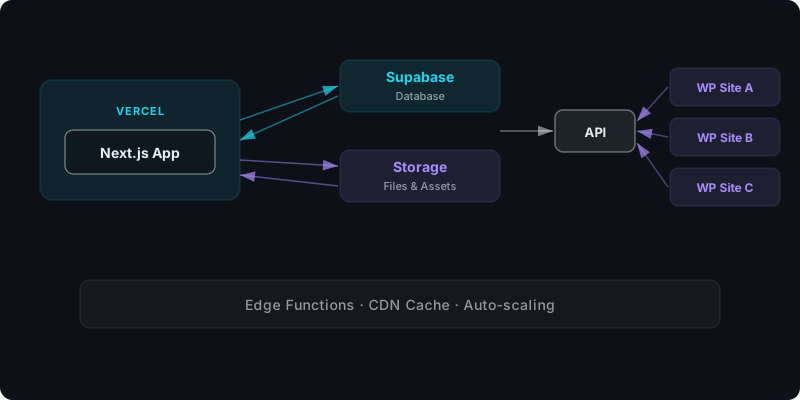
Direct answer: what do you need to deploy on Vercel?
- Vercel project for the app
- durable object storage for component artifacts
- environment variables configured in Vercel
Why storage matters on Vercel
In serverless environments:
- files written during a request are not guaranteed to persist
- multiple instances may run concurrently
That means component artifacts cannot rely on local disk.
In serverless environments, use durable object storage in production.
Deployment steps (high level)
1) Create a Vercel project
- Create/import the project in Vercel
2) Configure environment variables
Configure the environment variables required by your deployment (storage, and any optional integrations you’ve enabled). Keep secrets in Vercel’s environment variable store (not in source control).
3) Configure durable storage for artifacts
In Vercel, you should store:
- component source archives (if you support rebuilds)
- built artifacts (
client.js,style.css, SSR bundle) - metadata
4) Verify SSR rendering endpoints
Once deployed:
- verify API routes return expected responses
- verify SSR output contains HTML for indexable pages
If you’re evaluating SSR vs CSR behavior, see: CSR vs SSR in WordPress.
Security and isolation notes
If you execute uploaded code server-side, isolation matters.
Depending on your environment and risk tolerance, you may choose:
- in-app builds with strict validation
- builds in a more isolated environment (CI) for stronger separation
See: From ZIP to WordPress: Publish a React Section That’s SEO-Friendly.
Ready to try it? Get started with WP Render Blocks.
FAQ
Can I use local filesystem storage on Vercel?
No, not reliably. Use durable object storage.
Will SSR be slower on serverless?
It depends on component complexity and caching. The goal is to cache SSR output and avoid unnecessary hydration.
For an overview of the full workflow, see how to use React components in WordPress with SEO support.
Summary
Deploying WP Render Blocks on Vercel is straightforward once you treat storage correctly:
- serverless app on Vercel
- persistent storage for artifacts
- SSR output for indexable pages