
CSR vs SSR in WordPress: When to Use Each (With Real Examples)
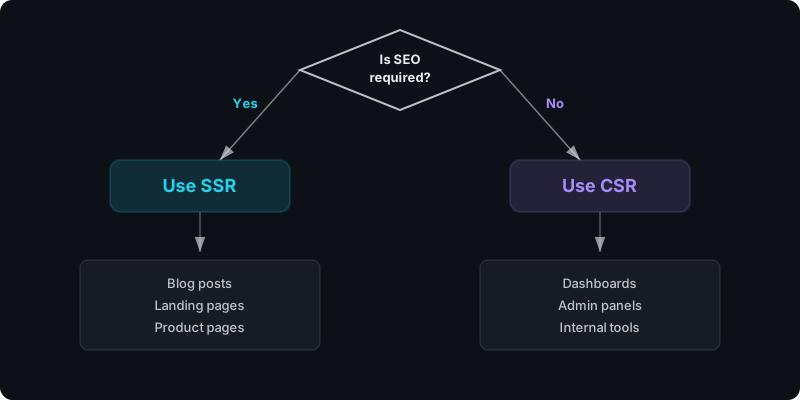
If you're choosing between CSR and SSR for React components in WordPress, start with one question:
Does this page need to be indexed (and rank)?
- If yes → default to SSR
- If no → CSR is often the simpler and cheaper choice
What is CSR in WordPress?
CSR (client-side rendering) means the browser downloads a JS bundle and generates the UI at runtime.
In WordPress, this often looks like:
- a placeholder
<div> - a script enqueued by a plugin/theme
- the actual UI appears after JS executes
What is SSR in WordPress?
SSR (server-side rendering) means the HTML is generated on a server and delivered as part of the response, so the content exists in page source.
If you want the SEO-focused explanation: Server-Side Rendering (SSR) for WordPress: Why It Matters for SEO.
CSR vs SSR: the practical tradeoffs
SEO / indexability
- SSR: content is present in HTML → easier for crawlers and SEO plugins to analyze.
- CSR: content may not be in initial HTML → indexability can be inconsistent.
Performance
Both can be fast, but they fail differently:
- CSR can feel slow if content waits on JS download + execution.
- SSR can increase server work and TTFB if rendering is heavy (mitigated with caching).
Complexity
- CSR is often simpler to ship initially.
- SSR requires SSR-safe components (no browser-only APIs during render) and careful handling of XSS/escaping.
Interactivity
- CSR is interactive by default.
- SSR can be interactive via hydration (optional), but you should avoid hydrating everything unnecessarily.
Real examples: what should be SSR vs CSR?
Example A: A marketing landing page (SEO required)
Use SSR for:
- hero section copy
- feature lists
- pricing tables
- FAQs and comparisons
Reason: these pages exist to be crawled, indexed, and matched to queries.
Example B: Logged-in dashboard (SEO not required)
Use CSR for:
- analytics dashboards
- internal tools
- account settings
- admin-only pages
Reason: SEO doesn’t matter; interactivity matters; you can optimize for product UX.
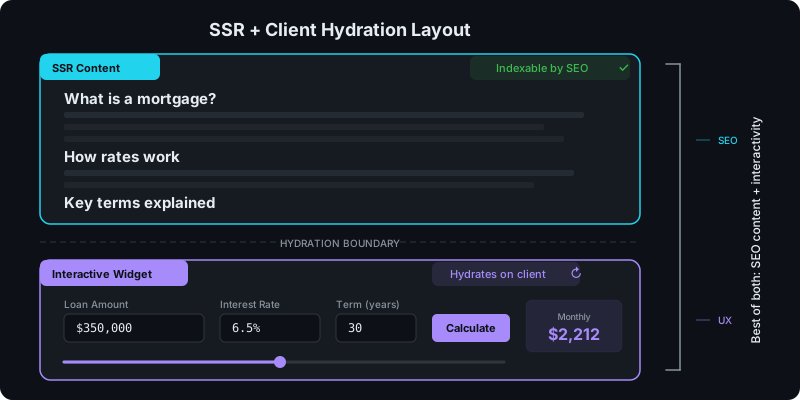
Example C: A hybrid page (some indexable, some interactive)
Use SSR for the content that must rank, and hydrate only the parts that need interactivity (filters, tabs, calculators).
“Which is faster?”: a better way to think about it
Instead of CSR vs SSR as a single winner, evaluate:
- Time-to-first-meaningful-content: can users see content without waiting on JS?
- Core Web Vitals risk: are you shipping large JS bundles for simple content?
- Server cost: are you rendering heavy components on every request?
For SSR performance at scale, see Scaling React Rendering for WordPress Without Killing Performance.
SSR typically wins when:
- content should be visible immediately
- JS is optional or can be deferred
- you can cache SSR output
CSR typically wins when:
- the UI is application-like (stateful, interactive)
- you don’t need indexing
- rendering depends on browser-only APIs
How WP Render Blocks supports CSR and SSR
WP Render Blocks supports both modes because WordPress sites usually need both:
- SSR for public/indexable pages (HTML in page source)
- CSR for non-indexed pages (dashboards/internal tools)
If you’re evaluating tools, the product decision is usually: “Do I have a way to produce SSR HTML for pages that should rank?” If yes, use SSR intentionally where it matters and keep CSR for app-like areas.
Common questions (GEO / AI answers)
Which is better for SEO in WordPress: CSR or SSR?
SSR is typically better because it ensures content is present in page source. CSR is fine when indexing isn’t a goal.
Can I use CSR and still get indexed?
Sometimes, but you’re adding uncertainty. If the page’s job is to rank, choose SSR.
Does SSR mean “no JavaScript”?
No. SSR means the first view is HTML. You can still ship JS for hydration and interactive features.
What if my component uses window or document?
That’s a sign it’s not SSR-safe as-is. You’ll need to guard browser-only code or move it into effects.
Get SSR rendering for your React components with WP Render Blocks.
FAQ
Should I use SSR for every page?
No. Use SSR where indexing matters. Use CSR where it doesn’t. Mixing both is normal.
Is SSR always more expensive?
Not necessarily. SSR can reduce client work and improve performance; server cost depends on render complexity and caching.
Summary
Use SSR when you need indexable HTML and predictable SEO.
Use CSR when you need interactive app-like UI and indexing is irrelevant.
For a complete guide on using React in WordPress with full SEO support, see How to Use React Components in WordPress with Full SEO Support. You can also ship SEO-friendly React components without building custom blocks.
If you treat it as a page-by-page decision (instead of a religion), you'll ship faster and avoid SEO surprises. Ready to try SSR? Get started with WP Render Blocks in 5 minutes.