
Why Running User-Uploaded React Code Is Dangerous (And How We Secure It)
If you allow users to upload React components and you render them server-side, you're operating a code execution platform.
That can be safe, but only if you design around a clear threat model.
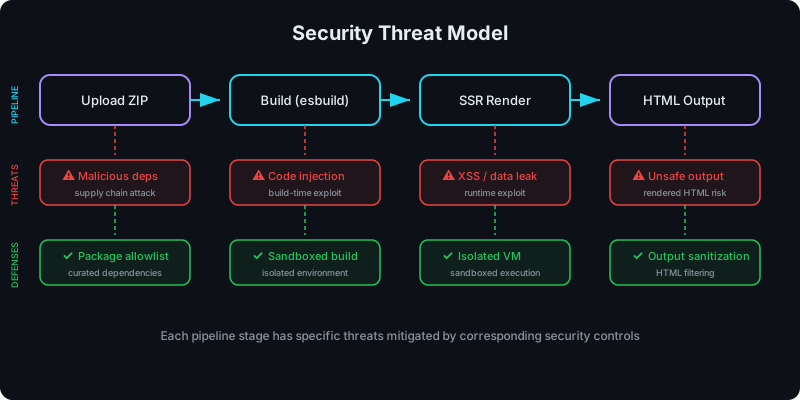
Direct answer: what’s dangerous about user-uploaded SSR?
The danger is not “React.” The danger is:
Untrusted code executing on your servers.
Even if your UI looks harmless, code can attempt to:
- access the filesystem
- spawn processes
- make outbound network calls (exfiltration)
- abuse CPU/memory (DoS)
- inject unsafe HTML into the output (XSS)
The threat model (what can go wrong)
1) Supply-chain risk (dependencies)
Dependencies can be:
- malicious
- compromised
- abandoned (and vulnerable)
AI-generated code makes this worse because it often adds packages opportunistically.
See: Using AI-Generated React Components in WordPress (Safely).
2) SSR execution risk (server capabilities)
Server-side rendering means code runs in a Node.js environment. Without controls, code might try to:
- read files
- run shell commands
- call external APIs
This is why package governance and execution isolation exist.
3) XSS risk (unsafe HTML output)
Even if server execution is locked down, output can still be dangerous:
dangerouslySetInnerHTMLwith untrusted props- unsafe markdown rendering
- “template” props that accept raw HTML
This can lead to XSS on the WordPress page that embeds the HTML.
4) Abuse / DoS risk
Attackers can attempt:
- huge uploads
- zip bombs
- expensive renders
- high request volume to SSR endpoints
This is why you need upload limits, timeouts, and rate limiting.
Mitigation checklist (practical)
Upload validation (block bad archives early)
- reject
node_modules/, build artifacts, secrets - enforce file count, path depth, and unzipped size limits
- prevent zip bomb patterns
Dependency governance
- keep production dependencies minimal and intentional
- review new or unfamiliar packages before shipping
- avoid packages that add server-side capabilities you don’t need
Isolation and sandboxed builds (optional)
Prefer builds in a more isolated environment (e.g., CI) rather than trusting ad-hoc builds in a request path.
Rate limiting for SSR APIs
SSR endpoints should be rate-limited to prevent abusive usage and to keep the service reliable.
See: Rate Limiting SSR APIs for WordPress: Best Practices .
WP Render Blocks handles security for you — get started free.
FAQ
Is SSR safe if you sanitize output?
Sanitization helps with XSS, but it does not address server execution risk. You need both.
Is this “security paranoia”?
No. If you execute user-uploaded code, security is part of the product.
For the complete guide to React in WordPress with SEO, see React Components in WordPress with Full SEO Support.
Summary
User-uploaded SSR is dangerous when treated casually.
It becomes manageable when you enforce:
- upload validation and limits
- dependency governance
- isolation where appropriate
- rate limiting
- safe HTML output practices