
Server-Side Rendering (SSR) for WordPress: Why It Matters for SEO
If you're putting React components into WordPress and you care about SEO, SSR is not a buzzword. It's a practical requirement:
SSR puts your content in the HTML response (page source).
That's the version of your page that search engines and SEO plugins can reliably analyze.
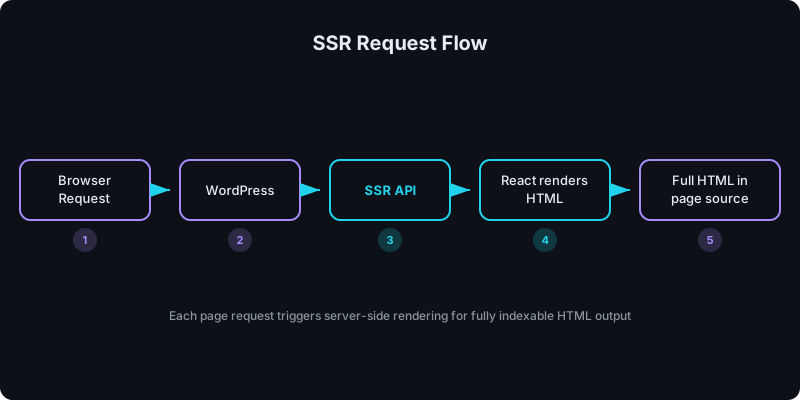
What is SSR (server-side rendering) in WordPress?
SSR means:
- A server runs your component’s render function.
- The server returns the resulting HTML.
- WordPress serves that HTML to the visitor (and crawlers).
This is different from “a React bundle that runs in the browser,” where the HTML response may contain only placeholders.
Why SSR matters for SEO (the short version)
Search engines can execute JavaScript in some cases, but relying on that creates three problems:
- Indexing becomes less predictable (timing, rendering differences, blocked scripts, etc.).
- SEO plugins analyze the HTML they can see; they don’t execute your JS app.
- Performance and UX can suffer if users must wait for JS to paint meaningful content. For a detailed look at how SSR affects LCP, CLS, and INP, see our Core Web Vitals guide for React components in WordPress.
SSR doesn't guarantee rankings, but it makes the content crawlable and consistent, which is a prerequisite for SEO to work.
Why CSR can “hurt SEO” in WordPress
CSR (client-side rendering) is often implemented as:
<div id="root"></div>
<script src="/bundle.js"></script>
The meaningful text exists only after the browser runs the script.
From an SEO perspective, this is risky for WordPress sites because:
- the initial HTML has little to analyze
- plugins like Yoast/RankMath evaluate the backend/editor content and/or server output
- some crawlers and previews won’t execute JS at all
When CSR is still OK (and often the right choice)
CSR is not “bad,” it’s just the wrong tool for some pages.
Use CSR when the page:
- is behind authentication
- is an internal dashboard
- is a tool where SEO doesn’t matter
- can tolerate JS dependency for content
If you want a decision guide with concrete examples, see: CSR vs SSR in WordPress: When to Use Each.
How SSR works with React (in simple terms)
React rendering is just a function that takes props and returns HTML output.
SSR runs that render step on the server.
Hydration (optional) can then attach interactivity on the client by loading a client bundle.
In practice, an SSR + hydration system needs to answer:
- What props are used for render?
- Where does the server run (runtime constraints)?
- How are assets (JS/CSS) served and versioned?
- How do we prevent XSS and unsafe execution?
How WP Render Blocks handles SSR for WordPress
WP Render Blocks is designed around a WordPress-friendly SSR model:
- Components are uploaded as ZIP files
- Bundling produces:
- a server render bundle (SSR)
- a client bundle for hydration (optional)
- a CSS bundle
- WordPress requests SSR output and receives HTML that it can include in page source
If you want the system overview, see: How It Works.
If you want the practical workflow version, see: From ZIP to WordPress: Publish a React Section That’s SEO-Friendly.
Who should care about SSR the most?
SSR is highest ROI for:
- marketing pages (hero sections, product pages)
- content pages (FAQs, comparisons, landing pages)
- listings where text and structure should be indexable
- pages targeting featured snippets (question/answer sections)
What does SSR not solve?
SSR does not automatically fix:
- poor information architecture
- thin content
- duplicated pages
- slow media (unoptimized images)
- unclear headings or lack of internal linking
SSR is the foundation: it makes your content present and analyzable.
Alternatives to SSR (and why they’re usually compromises)
“Just rely on Google rendering JavaScript”
Sometimes it works. Often it’s inconsistent. It also makes audits harder because “view source” won’t match what you see in the browser.
“Use headless WordPress”
Headless can be great, but it’s a platform decision (hosting, preview, caching, editor workflow). Many teams don’t need that complexity just to ship reusable React blocks.
“Build everything as custom Gutenberg blocks”
This is valid, but comes with ongoing maintenance and versioning responsibilities. If the goal is to ship React UI quickly (especially AI-generated UI) across multiple sites, the operational cost can be high.
Get SSR rendering for your React components with WP Render Blocks.
FAQ
What is SSR in WordPress (one sentence)?
SSR in WordPress means the HTML for your component is generated server-side so it appears in page source.
Does SSR guarantee better rankings?
No. SSR helps with indexability and consistency, which are prerequisites. Rankings still depend on content quality, intent match, authority, and competition.
Can I mix SSR and CSR on the same site?
Yes, and you should. Use SSR where indexing matters, CSR where it doesn't. To confirm Google is actually indexing your SSR content, see how to verify your React components are indexed.
Summary
If you want React components inside WordPress pages and you want those pages to be reliably crawlable, SSR is the safest default:
- SSR → content in page source
- CSR → content after JavaScript
From there, you can choose CSR intentionally for non-indexed experiences instead of accidentally shipping empty HTML to Google.
Ready to deploy? Follow our guide to deploying SSR components on Vercel.